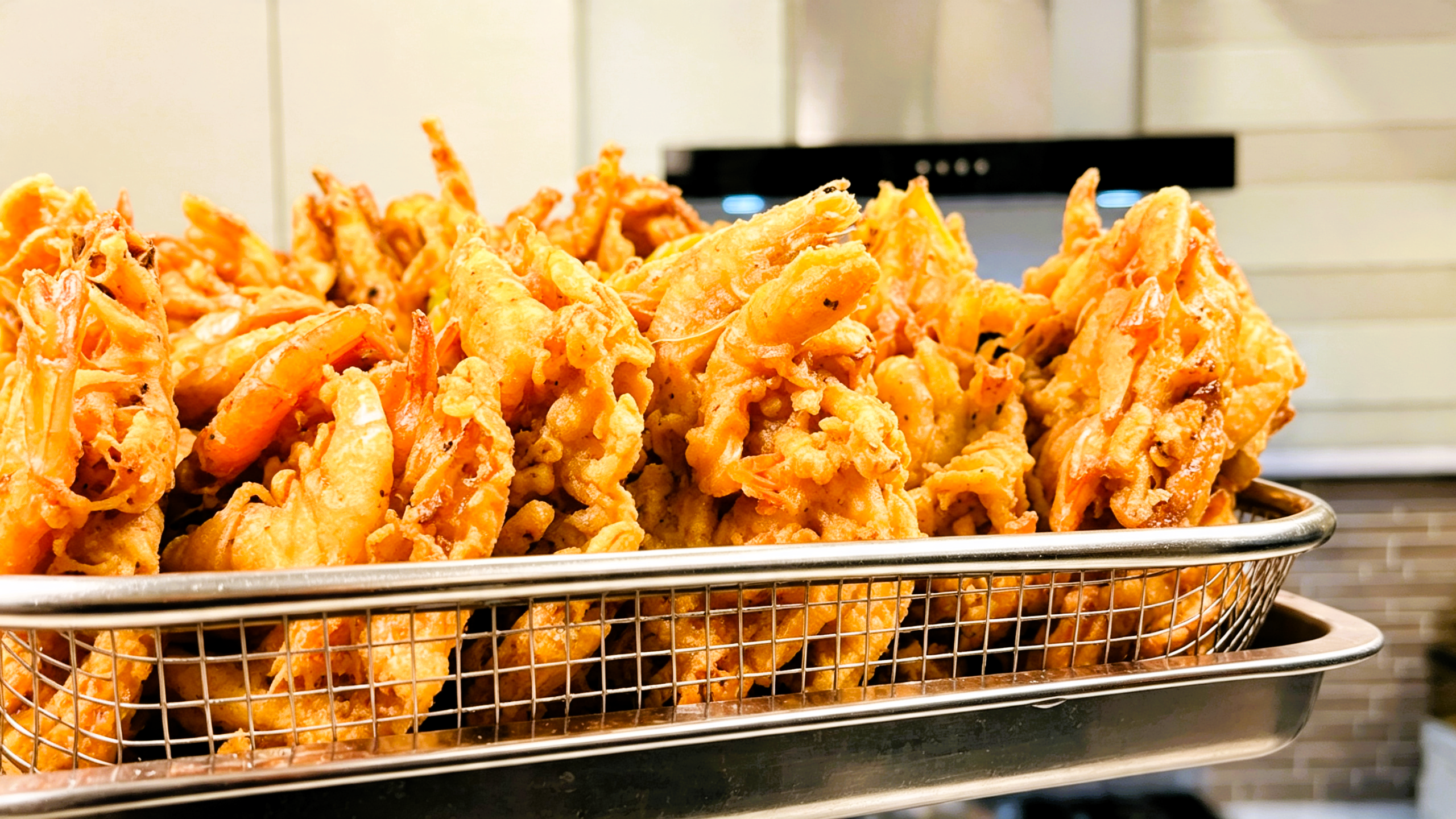
Crispy Okoy Recipe: The Secret to Light, Crunchy Filipino Shrimp Fritters
Crispy Okoy Recipe: What Makes It So Crispy?
This Crispy Okoy Recipe is one of my favorite Filipino shrimp fritters because it combines whole shrimp with thinly sliced vegetables in a light, crispy batter. But if you’ve ever made okoy before, you probably know the challenge: how do you make okoy super crispy without making it hard, and how do you keep that crispness from disappearing too quickly?
For this recipe, I tested several different flour combinations to find the texture I liked best. I experimented with all-purpose flour combined with rice flour, corn flour, cornstarch, and potato starch. Each combination produced a slightly different kind of crunch.
My personal favorite was actually potato starch + all-purpose flour because the resulting crisp was incredibly light and almost effortless to bite. However, the crispness tended to soften more quickly, particularly in the middle of the okoy.
The combinations using rice flour, corn flour, or cornstarch with all-purpose flour held their crispness longer. Since I didn’t have potato starch available on the day I filmed this recipe, I used my all-purpose flour and rice flour combination, which gave me a very crispy okoy that wasn’t hard and still had noticeable crunch hours later.
And honestly, I don’t mind if okoy eventually loses some of its crispness because okoy is best eaten while hot or warm, especially when served with a fresh, spicy vinegar dip.
What Is Okoy?
Okoy, also spelled ukoy, is a traditional Filipino fritter made with shrimp and vegetables. It is commonly made with small shrimp, although larger shrimp can also be used. The shrimp are combined with vegetables such as squash, carrots, sweet potato, bean sprouts, green papaya, or onions, then bound together with a thin batter and deep-fried until golden and crispy.
What makes Filipino okoy different from an ordinary vegetable fritter is the combination of crispy vegetables and shrimp, often with whole shrimp visible on top of the fritter.
Okoy is commonly served as a snack, appetizer, merienda, or side dish. It is especially delicious with a vinegar dipping sauce containing garlic, chilies, onions, and calamansi.
Why This Crispy Okoy Recipe Stays Crispy
The secret to crispy okoy isn’t just one ingredient. The flour combination, amount of water, vegetable moisture, thickness of the batter, and frying temperature all work together.
For this recipe, I use all-purpose flour and rice flour. The all-purpose flour provides structure and helps bind the vegetables and shrimp, while the rice flour contributes to the crisp texture.
Another important factor is moisture.
Squash and onions naturally contain a lot of water. Once salt is added to the vegetables, they begin releasing moisture. Instead of treating this as a problem, I use that moisture as part of the batter.
I also recommend frying the okoy over medium-low to medium heat. This allows the okoy to cook more gradually instead of browning too quickly while the inside is still moist.
As the okoy fries, moisture is converted to steam and escapes. The longer, controlled frying allows more moisture to leave the fritter, resulting in a drier and crispier crust.
However, the oil should not be too cool. If the temperature is too low, the okoy can absorb more oil and become greasy instead of crispy.
My Flour Experiments for Okoy
I tested several combinations before deciding on the flour mixture for this recipe.
All-Purpose Flour + Rice Flour
This combination produced a very crispy but not hard okoy. The texture remained pleasant to eat and, in my testing, the okoy still had noticeable crispness even after several hours.
This is the combination I used for the actual video recipe.
All-Purpose Flour + Corn Flour or Cornstarch
This combination also produced an excellent okoy. In my testing, the fresh texture was particularly nice. The crunch was light and easy to bite, with a pleasant crispy-but-soft quality.
It did, however, lose its crispness somewhat sooner than the rice flour combination. But this is not noticeable unless you do your experiments.
All-Purpose Flour + Potato Starch
This was actually my favorite texture when eaten fresh. The crispness was extremely light and effortless to bite. It wasn’t a hard or tough crunch at all.
The downside was that the middle of the okoy tended to become soft sooner compared with the rice flour combination.
For me, this isn’t a major problem because okoy is best eaten hot or warm anyway. If you’re serving the okoy immediately, potato starch is definitely worth to use.
100% Rice Flour
I also tested rice flour by itself. It stayed crispy for a very long time, but the texture was noticeably harder.
That’s why I prefer combining rice flour with all-purpose flour. The all-purpose flour helps give the okoy a more pleasant bite while the rice flour helps maintain crispness.
My Favorite Choice
If I’m eating the okoy immediately, I really like the potato starch + all-purpose flour combination.
But for this particular recipe, I used rice flour + all-purpose flour because potato starch wasn’t available when I filmed the video.
The rice flour combination gave me the balance I wanted: crispy, not excessively hard, and able to retain crunch for a longer time.
8 Tips for Super Crispy Okoy
1. Keep the vegetables thinly sliced
Thin julienned vegetables cook more quickly and allow moisture to escape more easily.
2. Don’t make the batter too thick
The batter should be enough to bind the vegetables and shrimp together. You don’t want a thick coating that hides the vegetables.
3. Add water gradually
Different flours have different absorption rates. Even if the recipe calls for 3 cups of water, don’t automatically add everything at once.
Add the water gradually until you achieve the right consistency.
4. Don’t overcrowd the pan
Too many okoy in the pan can lower the oil temperature and make the fritters absorb more oil.
5. Use medium-low to medium heat
Controlled frying gives the moisture more time to escape without allowing the outside to brown too quickly.
6. Watch the bubbling
As the okoy cooks, the bubbling should gradually decrease. This is one indication that moisture is being driven out of the fritter.
7. Serve it hot or warm
Even a very crispy okoy will eventually soften because the vegetables contain moisture. For the best texture, serve your okoy while it is still hot or warm.
8. Add the Dry Mixture All at Once
Prepare the complete dry mixture first, including the rice flour, salt, ground black pepper, and garlic powder. Add the entire dry mixture to the vegetables before mixing.
Avoid mixing the vegetables with salt alone or with only the seasonings first, especially if you’re going to let them sit. Salt can draw moisture out of the vegetables, which can make the mixture wetter than we want.
By having the rice flour already included when the vegetables are seasoned, the flour can immediately help absorb and bind the moisture released by the vegetables. This helps you maintain the right consistency and contributes to a crispier okoy.
Crispy Okoy Recipe: Super Crispy Filipino Shrimp Fritters That Stay Crunchy
Ingredients
For the Vegetables
- ½ medium-sized squash julienned
- 2 medium carrots julienned
- 4 medium white onions julienned
- 4¼ tsp ground black pepper
- 4¼ tsp garlic powder
- 8½ tsp salt or 2 tbsp + 2½ tsp
- 2 cups + 2 tbsp rice flour
The above will give you 17 cups julienned vegetables (about 130 grams per cup)
The seasoning/dry mix ratio: For every 1 cup of vegetables, use 1/4 tsp ground black pepper , 1/4 tsp garlic powder, 1/2 tsp salt, and 2 tbsp rice flour
For the Crispy Batter
- 2 cups all-purpose flour
- 2 cups rice flour
- 2 tsp salt
- 2 tsp ground black pepper
- 2 tsp annatto powder
- 3 cups room-temperature water added gradually (Different flours have different absorption rates. Even if the recipe calls for 3 cups of water, don’t automatically add everything at once. Add the water gradually until you achieve the right consistency.)
You can use other starches such as potato starch, cornstarch, or corn flour. Each one produces a slightly different type and duration of crispness.
Other Ingredients
- ½ kg small to medium shrimp Trim off the sharp, pointed parts of the head and tail using kitchen scissors, especially the sharp spikes around the head and the pointed tip of the tail.
- Cooking oil enough for deep frying
Yield: Approximately 34-40 pieces, using about ½ cup of vegetable mixture per Okoy.
For the Vinegar Dip
- 1½ cups cane vinegar
- 1 medium cucumber finely diced
- 2 medium red onions finely chopped
- 5 cloves garlic finely minced
- 4-6 pcs red chilies finely chopped, optional
- 1 tsp ground black pepper
- 1 tsp salt
- 2 tsp sugar
- 2-3 tbsp calamansi juice
Instructions
Prepare the Vegetables
- Julienne the squash, carrots, and white onions.
- Measure the vegetables. This recipe uses approximately 17 cups of sliced vegetables.
- Add the salt, ground black pepper, garlic powder, and rice flour. Toss thoroughly.
- Allow the vegetables to sit for several minutes so the salt can draw out some of their natural moisture.
Prepare the Batter
- In a large bowl, combine the all-purpose flour, rice flour, salt, ground black pepper, and annatto powder.
- Gradually add the room-temperature water while mixing.
- Do not add all the water automatically. Add it slowly until you get a batter that is fluid enough to coat and bind the vegetables but isn’t excessively thick.
- Add the seasoned vegetables and mix until they are lightly coated.
Assemble the Okoy
- In a small plate, place ½ to 1 tablespoon of batter and spread it into a thin layer.
- Scoop approximately ½ cup of the vegetable mixture and spread it evenly over the batter. Keep the okoy relatively thin rather than making it too thick.
- Arrange the whole shrimp on top of the vegetables.
- Lightly drizzle a small amount of batter over the shrimp, just enough to coat and hold them in place.
- Carefully slide the assembled okoy into the hot oil and fry according to the cooking instructions.
Fry the Okoy
- Heat enough cooking oil for deep frying.
- Carefully slide the assembled okoy into the hot oil and fry.
- Maintain the heat around medium-low to medium.
- Carefully fry the okoy until the bottom becomes firm and golden.
- Turn the okoy and continue frying until both sides are golden, crisp, and firm.
- Continue frying until the bubbling decreases significantly.
- Remove the okoy from the oil and drain well.
- Repeat with the remaining mixture, making sure not to overcrowd the pan.
Make the Vinegar Dip
- Combine the cane vinegar, cucumber, red onion, garlic, chilies, black pepper, salt, sugar, and calamansi juice.
- Mix well and allow the dip to sit for about 20-30 minutes before serving.
- Serve the crispy okoy with the vinegar dip while hot or warm.
Storage
Refrigerator:
Allow leftover okoy to cool completely before storing. Place in an airtight container and refrigerate for 3-4 days.
Freezer:
Okoy can also be frozen for longer storage. Allow the fried okoy to cool completely, then arrange the pieces in a single layer on a tray and freeze until firm. Transfer them to a freezer-safe container or zip-top freezer bag, placing parchment paper between layers if needed to prevent sticking.
For best quality, use frozen okoy within 1-2 months. It may remain safe for longer when continuously frozen, but the texture and crispness can gradually decline.
Reheating Okoy
Air Fryer
You can reheat already-fried okoy in an air fryer, although it may not have exactly the same texture as freshly deep-fried okoy.
To bring back some of the crispness, place the refrigerated or frozen okoy in a preheated air fryer at 160°C (320°F) for about 5-10 minutes, depending on the size and thickness.
There’s no need to add oil. Arrange the okoy in a single layer and avoid overcrowding.
Since the okoy is already cooked, the goal is simply to heat it through and remove some of the surface moisture, which helps restore its crispness.
Tip: Start checking at around 5 minutes. Smaller or thinner okoy may need less time, while thicker pieces may need a little longer.
Reheating in Cooking Oil
For the crispiest result, you can reheat refrigerated or frozen okoy in hot cooking oil.
For refrigerated okoy: Heat the oil over medium heat and fry for about 1-2 minutes per side, or until heated through and crisp.
For frozen okoy: You can fry it straight from frozen. Use medium heat and fry until hot and crispy, turning as needed. Avoid very high heat because the outside can brown too quickly while the inside is still cold.
Drain well on a wire rack before serving.
Frequently Asked Questions
Why is my okoy not crispy?
Excess moisture, an overly thick batter, low oil temperature, or overcrowding the pan can all make okoy less crispy. Make sure the batter is relatively light, the oil is hot enough, and the okoy has enough time to cook and release moisture.
Why do you use rice flour in okoy?
Rice flour helps create a crispier crust. In this recipe, it is combined with all-purpose flour to balance crispness with a more pleasant, less hard bite.
Can I use potato starch instead of rice flour?
Yes. I tested potato starch with all-purpose flour and actually preferred its very light and effortless crunch when the okoy was fresh. However, it tended to soften sooner than the rice flour combination.
Can I use cornstarch or corn flour?
Yes, you can use either. In my testing, all-purpose flour combined with corn flour produced a very pleasant, light crunch.
Why do you fry okoy over medium-low to medium heat?
The goal is to allow the okoy enough time to cook and release moisture without browning the outside too quickly. Controlled frying helps produce a drier and crispier fritter.
However, don’t use extremely low heat. If the oil temperature is too low, the okoy can absorb excessive oil and become greasy.
Can I make the okoy without shrimp?
Yes. You can make a vegetable-only fritter, although it will technically be closer to a vegetable fritter than traditional shrimp okoy.
Can I use different vegetables?
Yes. You can experiment with vegetables commonly used in okoy such as squash, carrots, sweet potato, green papaya, bean sprouts, or onions. Keep in mind that vegetables have different moisture contents, so you may need to adjust the batter consistency.
Why does crispy okoy eventually become soft?
The vegetables contain moisture. Even after frying, some moisture remains inside the fritter and gradually migrates toward the crispy crust. This is why okoy is best enjoyed while hot or warm.
How do I keep okoy crispy longer?
Use a thin batter, avoid excessive water, fry at a controlled temperature, don’t overcrowd the pan, and fry until much of the moisture has evaporated. Rice flour can also help extend the crisp texture compared with some other flour combinations.
Crispy Okoy Recipe Video
For more recipe videos, visit our YouTube channel, Onyok Kokok, by clicking the link below.
https://www.youtube.com/@onyokkokok8538
Discover more step-by-step written recipes by clicking the link below.
Filipino Recipes & Cooking – Onyok Kokok Kitchen
Final Note
After testing different flour combinations, I found that there isn’t necessarily one flour that is perfect for every situation.
Potato starch + all-purpose flour gave me my favorite fresh crunch because it was incredibly light and easy to bite. However, it softened sooner.
Rice flour + all-purpose flour gave me a more durable crunch, which is why I chose it for this recipe. It stayed crispy longer while still being pleasant to eat.
At the end of the day, though, I don’t think okoy needs to stay crispy for six hours. Okoy is at its best when freshly fried and served hot or warm, especially with a sharp, garlicky, spicy cane vinegar dip.
The real secret is finding the right balance between flour, moisture, batter consistency, frying temperature, and frying time.
I hope you enjoy this crispy okoy recipe as much as I enjoyed testing it!